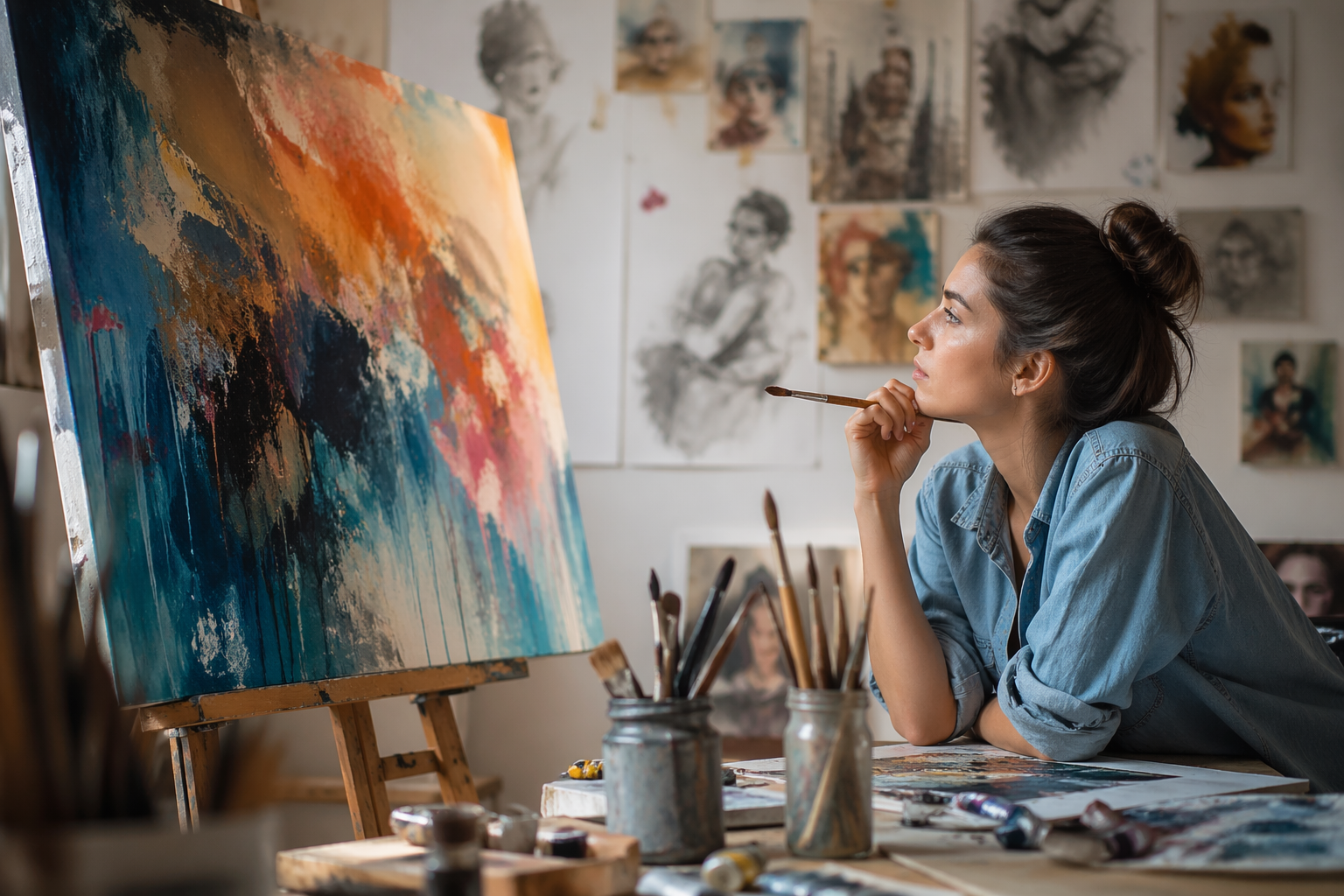
You sit down with a blank page. No instructions. No single correct answer. No step-by-step formula. Just space. And in that space, something powerful begins to happen.
At ART CENTER, we see it every day. Art isn’t just about color, texture, or technique. It’s about strengthening the way people observe, question, analyze, and respond to the world around them.
That’s where critical thinking in art quietly takes shape. Not in lectures. Not in memorization.
But in the act of creating. Let’s talk about why that matters more than ever.
Art Is Problem-Solving in Disguise
Every artistic decision asks a question:
Is this composition balanced?
Does this color create tension?
What happens if I remove this element?
How do I express this idea visually?
Art demands evaluation. It requires adjustment. It encourages experimentation.
And that process builds real-world thinking skills that go far beyond the studio.
When students engage in art-based learning, they aren’t just making something beautiful. They’re analyzing relationships, testing solutions, and revising outcomes in real time.
That’s cognitive training. And it doesn’t feel like homework.
The Brain Loves a Creative Challenge
Neuroscience continues to explore the cognitive benefits of art, and the findings are compelling.
Creating art activates multiple regions of the brain at once:
-
Visual processing centers
-
Motor coordination systems
-
Emotional regulation areas
-
Executive function networks
-
Memory integration pathways
Few activities demand that level of whole-brain engagement.
When someone works through composition challenges, perspective drawing, or conceptual storytelling, the brain forms new connections.
That’s not just creativity. That’s brain development through art. And it applies to children, teens, and adults alike.
There’s No Single Right Answer
Traditional education often rewards speed and correctness. Art does something different. It rewards exploration.
In the studio, students learn to:
-
Compare possibilities
-
Justify choices
-
Reflect on outcomes
-
Revise without fear
-
Accept ambiguity
This strengthens creative learning skills that translate into academic performance, workplace innovation, and personal decision-making. When someone asks, “Why did you choose that?” they begin articulating reasoning. When someone revises a design, they practice adaptability.
When someone critiques respectfully, they build analysis and empathy.
Art becomes a training ground for thinking clearly — and thinking independently.
Mistakes Become Data
In many settings, mistakes feel final. In art, they’re information. A line goes wrong?
Adjust it.
Color feels off? Layer over it.
Composition feels crowded? Remove elements.
That process teaches evaluation instead of panic. It encourages reflection instead of avoidance. Students begin to see obstacles as puzzles instead of failures. This is where art for cognitive growth becomes visible. Because resilience and reasoning are deeply connected. And both are practiced every time someone decides to try again.
Observation Changes Everything
Before you can create, you must observe.
Artists learn to notice:
-
Subtle shifts in shadow
-
Negative space between objects
-
Texture variations
-
Emotional tone
-
Visual hierarchy
That level of attention sharpens perception. And sharper perception strengthens analysis. Observation fuels insight. Insight fuels judgment. Judgment fuels decision-making. This is learning through creativity at its most practical. The more carefully someone sees, the more intelligently they respond.
Art Builds Flexible Thinking
In a rapidly changing world, flexibility matters. Art trains adaptability in ways that feel natural. A project shifts direction. Materials behave unexpectedly. Ideas evolve mid-process.
Instead of resisting change, artists adjust:
-
They evaluate
-
They rework
-
They refine
That kind of mental flexibility strengthens executive functioning — the ability to plan, prioritize, and self-correct. It’s one of the most overlooked cognitive benefits of art, yet it shows up everywhere:
-
Academic performance
-
Workplace collaboration
-
Conflict resolution
-
Strategic planning
-
Innovation development
Art teaches you how to pivot without losing your vision. That’s powerful.
Discussion Deepens Thinking
At ART CENTER, projects don’t end when the paint dries. They continue through conversation.
Critique sessions encourage students to:
-
Explain their intentions
-
Analyze visual impact
-
Offer constructive insight
-
Consider alternative perspectives
-
Reflect on growth
These discussions strengthen reasoning skills in real time. Students learn to defend ideas without becoming defensive. They learn to listen without shutting down. They learn to think before responding. That’s applied critical analysis — developed organically through the creative process. And it reinforces the foundation of critical thinking in art in ways that traditional lectures simply can’t.
Art Strengthens Focus in a Distracted World
We live in constant stimulation. Notifications. Scrolling. Multitasking. Art slows that down.
Creating requires sustained attention. When someone spends an hour refining shading or balancing a composition, they practice deep focus.
And deep focus strengthens cognitive endurance.
Over time, that endurance improves:
-
Task completion
-
Information retention
-
Emotional regulation
-
Strategic problem-solving
It’s not just about producing artwork. It’s about training the mind to stay engaged. That’s where brain development through art becomes a long-term investment rather than a temporary activity.
Why This Matters for All Ages
Critical thinking isn’t age-specific. Children build foundational reasoning. Teens refine analytical independence. Adults strengthen adaptability and innovation.
Through art-based learning, every age group develops skills that extend into daily life:
-
Evaluating information
-
Considering alternatives
-
Recognizing patterns
-
Synthesizing ideas
-
Communicating clearly
Art doesn’t replace academic subjects. It strengthens the way students approach them. It doesn’t compete with logic. It enhances it. When creativity and reasoning work together, growth accelerates.
Strategic Benefits of Artistic Thinking
Engaging in structured art education supports:
-
Stronger executive functioning
-
Improved spatial reasoning
-
Increased emotional intelligence
-
Enhanced memory retention
-
Better decision-making under uncertainty
-
Stronger analytical communication
-
Greater intellectual confidence
-
Sustainable cognitive development
These aren’t abstract benefits. They show up in classrooms: In boardrooms, in conversations,
in leadership. And they begin with a brushstroke.
The Studio as a Thinking Laboratory
When someone walks into ART CENTER, they may expect to learn technique.
What they gain is something deeper. They learn how to approach complexity without fear. They learn how to examine details without losing the whole. They learn how to revise ideas without abandoning them. They learn how to think. And that skill carries forward into everything else. Because art isn’t separate from intelligence. It strengthens it.
Conclusion
Art does more than fill space on a wall. It fills space in the mind. It challenges assumptions.
It encourages analysis. It rewards patience. It builds confidence in decision-making.
In a world that demands adaptable thinkers, observant leaders, and innovative problem-solvers, the studio becomes more than a classroom. It becomes preparation.
Not just for making art. But for thinking clearly, responding thoughtfully, and navigating complexity with confidence. And that kind of growth lasts long after the paint dries.